

New DIX data reveals significant gap between intention and action
The new DIX benchmark 2022-2025 paints a confronting picture of sustainable employability among Dutch workers. Although almost seven in ten employees say that employability is important to them, only 29 percent actually have sufficient control over the development and future-proofing of their work. This is worrying, because personal control is one of the strongest predictors of long-term sustainable employability.
In addition, mental fatigue continues to increase, and resilience is under considerable pressure. The results are based on 15,685 respondents, 85.4 percent of whom completed the questionnaire via the Johan platform.
1. Mental fatigue is increasing rapidly
The figures show a clear deterioration:
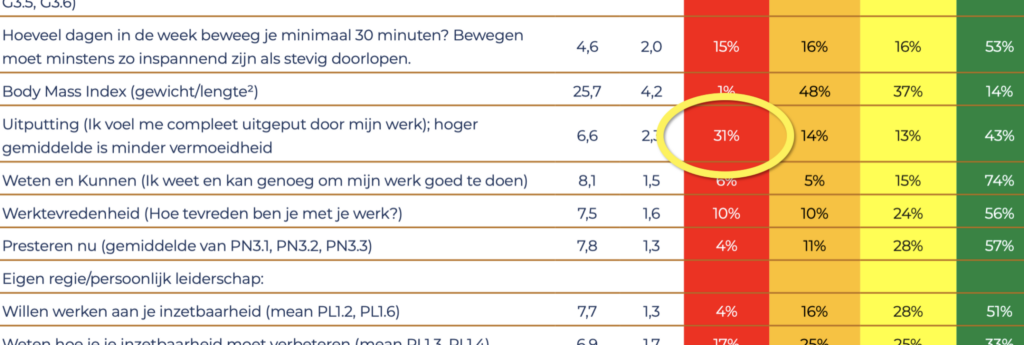
- 31% of workers feel completely exhausted by their work – a significant increase compared to previous years.
- Only 36% score positively on resilience. This indicates limited recovery capacity and difficulty coping with adversity.
- By way of comparison, in the 2019–2021 benchmark, only 10% suffered from severe fatigue, compared to 31% now. That is a threefold increase in just a few years.
This trend makes employees more vulnerable, especially in a labor market where changes are happening at an ever-increasing pace.
2. Knowledge and skills: strong foundation, but underutilized
There is also positive news:
74% of Dutch workers indicate that they have sufficient knowledge and skills to perform their work well.
However:
- 44% feel that their talents are not being used to their full potential at work.
- 55% indicate that they are able to learn and develop more actively.
The potential is therefore there, but it is not being sufficiently exploited.
3. Young people, those with practical training, and those working in healthcare, education, and hospitality are most at risk.
The differences between groups are significant:
- Young people (aged 16–34) most often report mental fatigue and feel they have less control over their employability.
- Practically trained individuals score lower on knowledge, skills, and self-management.
- Sectors such as healthcare, education, and hospitality rank among the lowest three in terms of job satisfaction, work-life balance, and mental resilience.
This combination makes these groups particularly vulnerable.
4. The biggest gap: considering employability important vs. actually doing something about it
What stands out:
- 69% consider sustainable employability to be important.
- However, 63% do not know how to improve their employability.
- And only 29% score green on personal leadership (own control).
This "wanting but not knowing how" is one of the most important conclusions of the benchmark.
5. Small interventions make a difference
The report shows that employees primarily need clear guidelines:
- Support from managers and colleagues.
- Accessible, low-threshold training courses.
- A work environment where learning and making mistakes are normal.
- More attention to mental strain and recovery moments.
Relatively small, structural improvements help employees take action more quickly.
6. Why these figures matter
The tension in the labor market remains high: there are almost as many job vacancies as there are unemployed people. At the same time, mental stress is increasing and work is changing faster than ever. This calls for:
- targeted policy on employability,
- customization per target group,
- better utilization of talent,
- and support in strengthening control.
With the DIX, organizations can separate facts from assumptions and focus on sustainable employability.
Download the full report
Would you like to view all data, tables, and sector analyses?
Download the full report here Sustainable employability: What can we learn from the DIX benchmark 2022–2025?